
Transportation Minute: Rates, Capacity, Operating-Cost Headwinds and Broker Tort Exposure After Caribe
Written by: David Jencks, Esq., Jencks Law, P.C.
At the IFA Transportation Factoring Meeting in Las Vegas (September 14–16, 2026), I walked through a freight market that has turned carrier-favorable on three fronts at once: spot rates, freight volume, and capacity. That improvement is real. It does not erase two structural pressures on transportation finance: insurance and diesel continue to compress carrier operating margins, and Supreme Court confirmation of broker negligent-hiring exposure is already reshaping freight access, payment terms, and insurance overhang across the brokerage chain.
This Transportation Minute re-caps that Las Vegas sequence as one continuous argument: rates, volume, and capacity first; then input cost headwinds; then the post-Caribe legal arc and its underwriting implications. The figures below illustrate points already in motion — they do not restart the analysis.
Freight Rates: The 2026 Break Off Multi-Year Lows
After the freight recession of 2023–2024, the monthly pre-fuel surcharge spot linehaul averages I showed in Las Vegas mark a decisive break higher through 2026. That series bottomed near $1.90 in mid-to-late 2025, then climbed from $2.30 in January 2026 to $3.20 by August 2026 — placing summer 2026 spots well above any monthly print in the 2023–2025 table. The path is cumulative, not a one-week board spike: each successive 2026 month stepped further off the trough, and by midsummer the red line on the chart had left the prior three years behind.
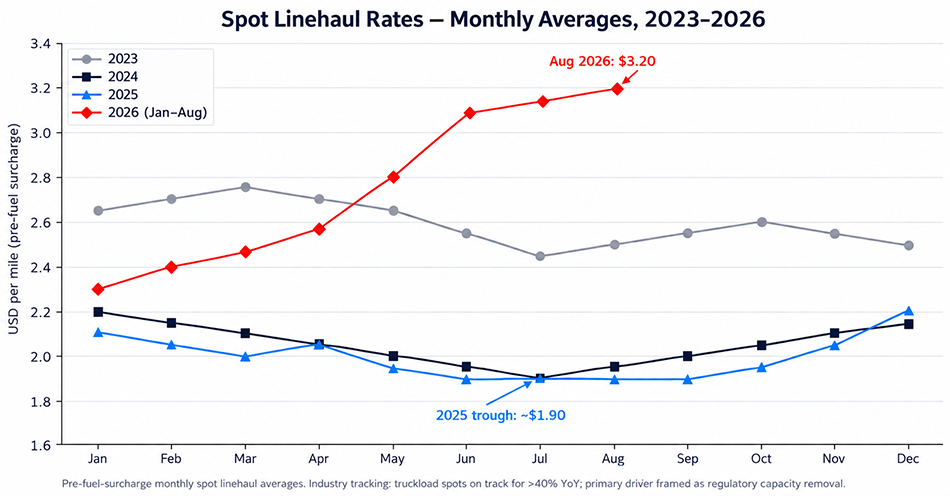
Figure 1. Monthly pre–fuel-surcharge spot linehaul averages, 2023–2026.
Truckload spot rates are on track for more than 40% year-over-year. The primary driver was not a classic demand boom: it was regulatory capacity removal — CDL and English Language Proficiency (ELP) enforcement plus attrition — supported by manufacturing strength. That distinction matters for receivables finance. Rate strength driven by supply exit can look like a recovery on the board while still leaving fleets fragile if diesel, insurance, or utilization deteriorate. The rate story, in other words, is incomplete without the volume and capacity chapters that follow.
Freight Volume: Stabilization, Not a Demand Spike
Volume is the quieter half of the same thesis. The Bureau of Transportation Statistics Freight Transportation Services Index traces the familiar arc — COVID collapse, rebound into 2021–2022, then the freight-recession slide into 2023–2024. The 2025–2026 portion of that path is best read as modest stabilization, not a demand surge that alone explains $3-plus spots. After three hard years, carriers are recovering pricing power primarily because trucks and drivers exited the market, not because every dock is suddenly overflowing. Volume that is merely better than the trough still leaves room for lane-level softness — and for cost shocks to erase rate gains.
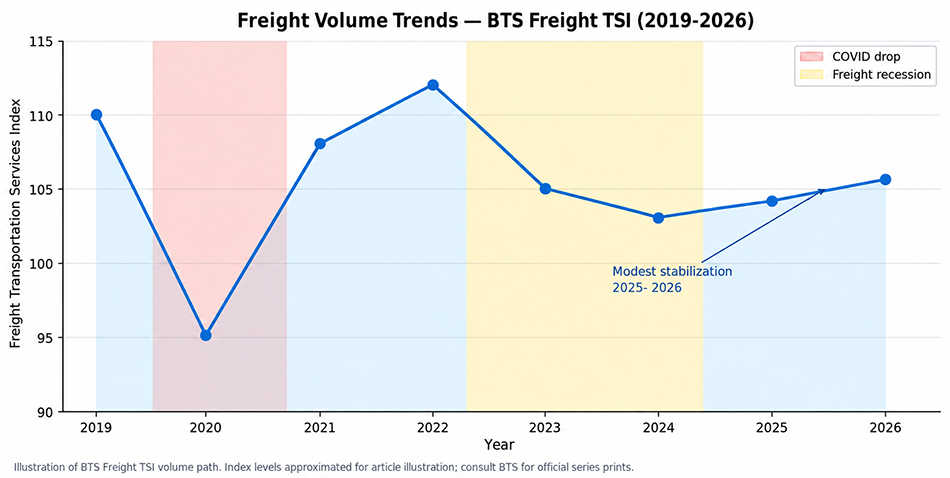
Figure 2. Freight volume path — BTS Freight Transportation Services Index, 2019–2026.
Taken with Figure 1, the implication is straightforward: the 2026 rate break is a capacity story first. That brings the analysis to the index that makes the point most clearly.
Freight Capacity: From Peak Oversupply to Significant Undersupply
Capacity is where the Las Vegas figures are most decisive. The Capacity Index (100 = balanced) ran from about 115 in January 2023 and a peak near 120 in July 2023 — heavily oversupplied — down through balance in October 2025 (100) into significant undersupply by March 2026 at about 92. That path is a multi-year grind from glut to shortage, not a one-month anomaly. Three overlapping drivers explain it: CDL restrictions, ELP enforcement, and structural driver attrition on the order of roughly 5,000–8,000 drivers per month. Higher utilization and carrier pricing power follow directly — precisely the environment that produces the upside in the spot series above.
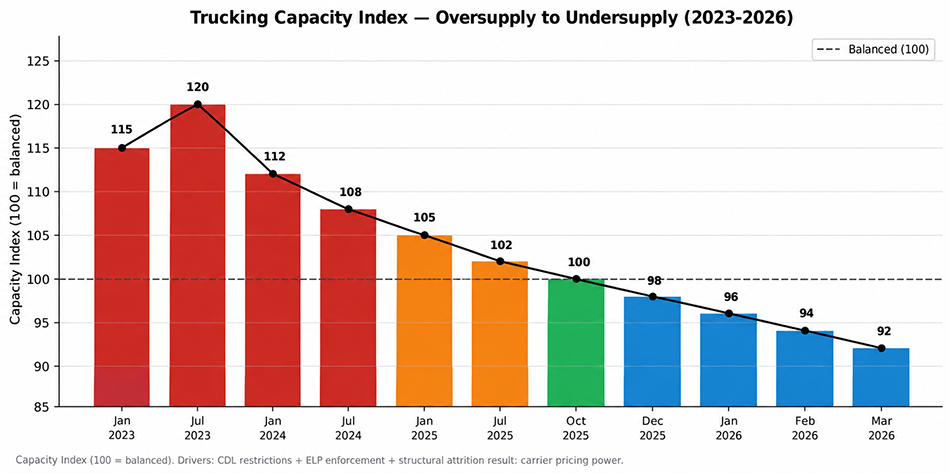
Figure 3. Capacity Index path (January 2023 ~115 → March 2026 ~92).
Non-domiciled CDL rule as a capacity driver. FMCSA’s Final Rule, Restoring Integrity to the Issuance of Non-Domiciled Commercial Drivers’ Licenses (91 FR 7044; published February 13, 2026; effective March 16, 2026), narrows issuance and renewal to applicants who prove lawful immigration status specifically in H-2A, H-2B, or E-2 categories. Employment Authorization Documents are no longer enough. The rule does not cancel every non-domiciled credential overnight, but it creates steady non-renewal and cancellation pressure as licenses expire, compounding ELP enforcement and ordinary attrition. DOT authority data I reviewed in Las Vegas likewise framed net-out conditions: regulatory exits continuing to outpace new grants in key segments. Credential and authority exits should be treated as credit events for Carrier clients who concentrated hiring in now-constrained pools.
Operating-Cost Headwinds: Insurance and Fuel
Rates higher, volume stabilizing, capacity tight — that combination is carrier-favorable on the freight side. It is not a free pass on the cost side. Two input lines from ATRI’s Operational Costs of Trucking remain central even when the rate board is firm.
Insurance. ATRI’s 2025 cost stack put total Class 8 operating cost near $2.26 per mile. Insurance was only about 4.5% of that stack — roughly $0.11 per mile — yet it remains the fastest-rising percentage. For Carrier clients, rising premiums and nuclear-verdict severity stay a margin and viability constraint even when linehaul is firm. For Broker clients, the same insurance market is now pricing post-Caribe selection exposure, discussed below. Fuel. ATRI puts fuel near 21% of operating cost, or about $0.481 per mile — still one of the largest single lines after driver wages and benefits. On top of that structural share, national on-highway diesel has been a 2026 headwind in its own right.
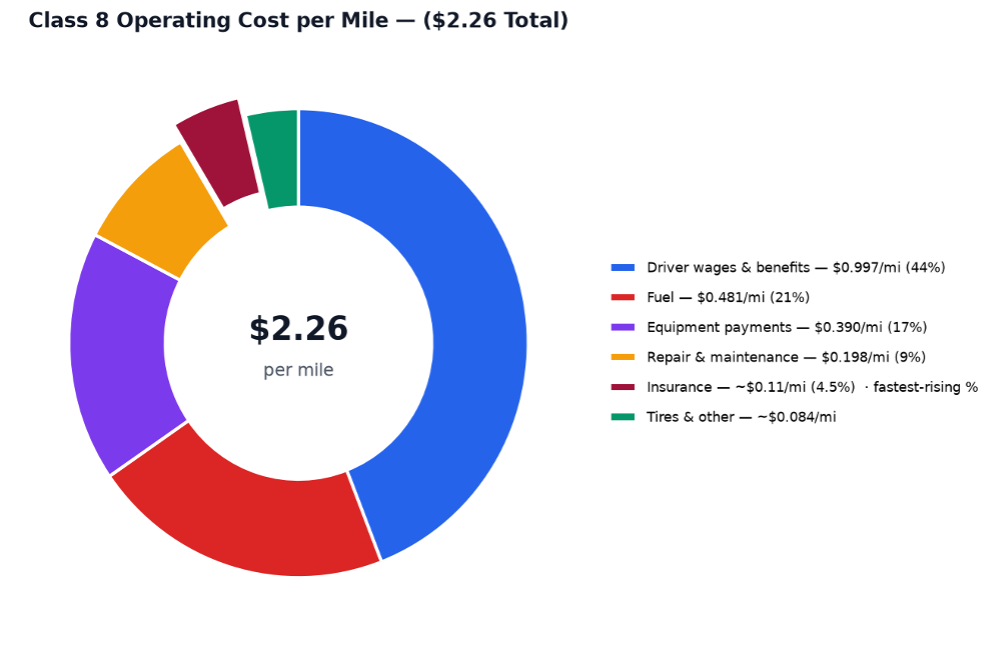
Figure 4. Class 8 operating-cost mix ($2.26/mi total).
EIA’s weekly national average printed $6.529 per gallon for the week of September 21, 2026 — up roughly $2.78 year-over-year versus $3.749 a year earlier — after an earlier March spike tied to Middle East / Strait of Hormuz disruption and a second climb into September highs. Fuel surcharges mitigate some of that pressure, but they often lag the pump and small carriers struggle to command them. Smaller and mid-sized fleets — the core of many Factor portfolios — rarely have the balance sheet depth to absorb that lag.
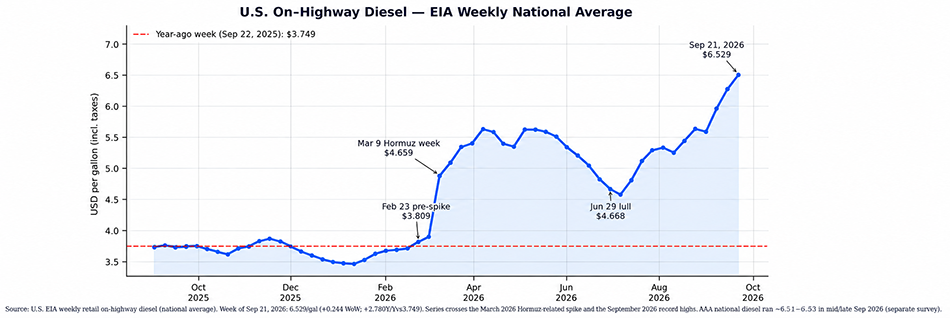
Figure 5. U.S. on-highway diesel — EIA weekly national average (September 2025–September 2026).
The freight fundamentals and the cost stack therefore pull in opposite directions for many Carrier clients. That tension is the bridge into the legal half of the Transportation Minute: even a firm rate tape does not neutralize broker-selection liability after Caribe.
After Caribe: Broker Tort Exposure and Hardy
The holding. In Caribe — the Supreme Court’s May 14, 2026 decision confirming broker exposure to state negligent-hiring suits — decided one week after the IFA Annual Conference in May — the FAAAA preemption dispute that had been a foundational industry question is no longer an early federal off-ramp for that theory of liability. Brokers selecting carriers face the traditional tort frame plaintiffs have long pressed under the statute’s safety exception.
The implication for transportation finance is practical, not doctrinal. In Las Vegas I walked the chain: if brokers face fifty state negligence regimes, insurance costs rise and barriers to entry increase; fewer small brokers survive; freight consolidates upstream toward larger, investment-grade intermediaries. Those brokers do not hand freight freely to new, small, or marginal carriers — many of whom factor. Better credit on the account-debtor side can arrive with worse pay terms (30 days drifting toward 45 or more) and with Factoring-as-a-Service offerings that compete directly for Factor clients. The Factor ecosystem has long depended in part on a thick middle of brokers who need working-capital partners; Caribe pressures that middle.
Broker reactions are already visible. Post-decision practice changes include C.H. Robinson no longer working carriers with Conditional (or Unsatisfactory) FMCSA safety ratings — accepting only Unrated or Satisfactory for certification; raising minimum auto liability from the federal $750,000 floor to $1 million; imposing a wait on new authorities before approval; and moving “high-risk” carriers (proprietary metrics drawing on FMCSA BASIC scores) to non-certified status. Landstar’s approved carrier pool was reported as shrinking from 100,000+ toward roughly 64,000 (about −35%) amid fraud and lawsuit risk. Other brokers are reportedly requiring longer authority seasoning, avoiding Conditionals, and denying on BASIC metrics with little explanation. Carriers face a parallel filter: shippers and brokers are raising coverage requirements — higher minimum auto liability to stay on approved lists — and both premium cost and availability hit the small and mid fleets Factors finance. The tension is structural: with spots over $3.00, brokers still seek lower-cost capacity, but lower-cost capacity is precisely what negligent-hiring exposure makes expensive to touch.
Trade reporting since May describes mid-double-digit moves on primary freight-broker auto liability, far larger shocks in excess layers — including examples of premiums jumping several times — with tighter terms, lower limits, and some London capacity exiting. That is the cash-flow mechanism behind small and mid-brokers getting culled.
Hardy case. Hardy et al. v. Bhupinder Singh et al., No. 3:23-cv-00207 (D. Nev.), matters for Factors less as a merits holding than as a risk signal. After Caribe, a broker that kept tendering to a carrier it knew was subcontracting loads without broker authority could not exit on summary judgment: Judge Anne R. Traum denied AONE’s motion on August 11, 2026. That order was not a liability finding — and plaintiffs’ claims against AONE were later dismissed with prejudice on September 10, 2026 — but the underwriting lesson is the survival of the claim itself. Known double-brokering and carrier authority issues now keep brokers, and their insurers and capital providers, in the conversation long enough for defense cost and settlement pressure to matter. These risks land as broker survivability first — and as a freight-access filter for the carriers those brokers will still tender to.
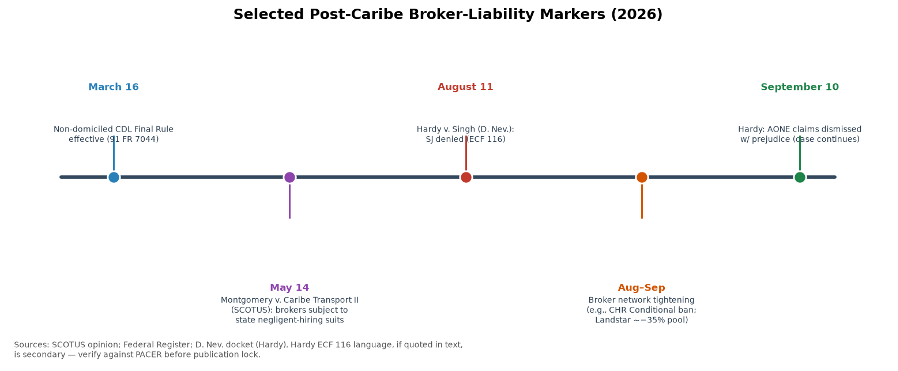
Figure 6. Selected 2026 broker-liability and related capacity markers (public milestones).
Implications
The principal implications for transportation receivables finance:
Read 2026 rate strength as a capacity story first — and underwrite the double squeeze on Carrier clients. Driver and authority attrition (CDL/ELP/non-domiciled renewals) is only half of it: large-broker Conditional bans, pool shrinkage, and BASIC denials cut marginal and newer carriers out of tender even when spots run over $3.00. Higher mandated auto liability limits are another gate alongside those bans and pool shrinkage — carriers that cannot buy or afford the raised coverage stay off approved lists. High boards do not equal freight if the approved pool has closed. Many carriers will not be able to get on the board.
Stress insurance and diesel even when linehaul is firm. ATRI’s $2.26 per mile stack still has fuel near $0.48/mi and insurance as the fastest-rising percentage; EIA diesel near mid-September highs makes surcharge lag a portfolio issue.
On Broker clients, price Caribe as a survivability question. Selection litigation, insurance costs, defense and settlement drag, and rising broker insurance will cull the small and mid-sized middle; survivors consolidate freight upstream:
On Brokers as debtors, watch pay trends moving to 40 days or more, freight moving upstream to brokers competing Factoring-as-a-Service or quick pay products that eats Factor relationships.
Looking Ahead
Late-2026 freight fundamentals tilt carrier-favorable on rates, volume stabilization, and capacity. That is a healthier backdrop for Factor portfolios than the 2023–2024 trough. It is not a reason to relax. The post-Caribe regime is already deciding which Brokers survive the insurance and litigation load — and which Carriers can still find drivers and freight once Conditional bans and pool shrinkage harden. Those who underwrite broker survivability, the diesel and insurance residual, and the freight-access squeeze on the carrier side will be best positioned as 2026 closes and 2027 capacity rules continue to tighten.
About David Jencks, Esq.
David Jencks is an attorney with more than 25 years of experience in transportation and transportation finance. He represents factors and transportation companies in both transactional matters and litigation. David is a member of the Transportation Lawyers Association and serves as co–general counsel to the International Factoring Association. For nearly two decades, he has been a featured keynote speaker at the IFA’s Annual Conference and its Transportation Factoring Meeting. He has also led numerous trainings and webinars on all facets of transportation factoring, including account management, credit, technology issues, fraud prevention, risk management, problem-load resolution, billing practices, and legal compliance. David can be reached at davidjencks@jenckslaw.com.
The views expressed in the Commercial Factor website are those of the authors and do not necessarily represent the views of, and should not be attributed to, the International Factoring Association.